Golden Reveries

Olympic-rings

I just watched Michael Phelps accept his 20th gold medal. The “Star-Spangled Banner” advanced through the Olympic stadium the way a summer breeze folds through a field of gilded corn.

The Olympics are an unparalleled advertisement for determination and dreams.

My dreams are not of circular necklaces, of being the best in the world. I dream of characters created, of known volumes filled with my words.

My father, the WWII history writer, just got his first rejection letter. The military publisher judged his life’s work economically unviable, which, in their defense, it is. I told my father I was sorry, but also said, he’d undergone a rite of passage and now had the email-proven bragging rights.

My message today is a simple one. A human one. We must never give up. Dream. Unabashedly. Without thought of future failure.

How, you ask? If I knew, I’d tell you. But, as I watch these Olympians, American swimmers, teenage gymnast-powerhouses, I simply know it’s possible. It can be.

My father will try again, with other publishers, a little more determined, blood pumping an altogether different mettle.

In the time it took me to type this post, Phelps won his 21st gold medal. Further solidifying his claim as the most decorated Olympian of all time.

Keep dreamin’. That gold may yet be yours.

Publishing Woes

FullSizeRender 10

It took my father 30 years to write a book. Thirty.

Even more if you count the year he spent planning. His book, an all-encompassing look at the British maritime campaign during World War II, is older than I am. It has 29 (ish) chapters, an introduction, footnotes, scores of research, and multiple trips to the United Kingdom’s National Archives in Kew to review original war documents.

This past Friday, he told me he submitted his book to two military publishers and received a letter from each. Both stated his book was under review by their editorial staff and they would get back to him in the next few months.

And so, he waits from afar as a stranger evaluates the value of his thirty-year pet-project.

I’m encouraged by my father. I, too, am taking the long route writing my book. My book spent eight years in pre-productions, and after nearly two years of writing, I have 100+ pages to show for it. What’s that they say about the tortoise and the hare? Cause I’m praying it’s true. For both our sakes.

Yet, I know my journey to publication will be much more challenging than my father’s. Sure, he still faces uncertainty. But his market is much smaller and the competition is effectively nonexistent.

This is not the case for us fiction writers.

Full disclosure: I have to actively stop my brain from going down the yellow-brick-road to publication because I am afraid of the arduous journey and the undetermined ending. I become discouraged at the odds. I begin to believe that my book is horrendous and no one will ever want it.

And I know I’m not on this island alone.

So many writers I admire had enough rejection letters to redecorate their apartments. Even J.K. Rowling received rejections on Harry Potter! And yet, Ms. Rowling persevered. She kept going.

By day, I’m actually a grant writer. And in the philanthropic world, there’s this fundraising philosophy built on the idea of getting a “no.” While the end game is raise funds for your respective program, the “no” is still an indicator that you’re doing your job as it means you asked, you took a risk, you received an answer. After all, you can’t make someone’s decision for him or her. You can ask. And if necessary, you can reform your question, strengthen your case, and learn from the experience. Then, you try again with someone else. You ask. You ask. And then you ask some more.

I think this is our job as writers. We ask. We take a leap of faith. We edit our novels. We seek advice of peers and professionals. We improve our characters’ voices and hone our themes. We remove paragraphs that no longer work (even if they have that one line in them that we LOVE), cut scenes without purpose (even if we think they’re hilarious), and we become stronger because of it. Our work becomes stronger because of it.

We learn even when we’re tired. We grow even when we’re frustrated. We dream even when it seems impossible.

I don’t know what will happen with my book. I don’t know what will happen with my father’s book. I have already invested ten years and hundreds of hours into this thing, this dream that I love. And as much as that yellow-brick-road scares me, I have to believe it can be something. That I will try and try and try until it becomes something.

So, I write, I believe, and one day I will start to ask.

As for my father, what will he do while he waits for the phone to ring? Why start his sequels, of course. (You read that right. Sequels. There are two.) So, Godspeed, Dad. We’re with you.

Revision Checklist for Writing Contests

This weekend is the annual pg70pit submission stretch! MG submits 7/1, YA submits 7/2, and adult submits 7/3. Before you submit, run that page through this wringer:

Lara's avatarLara Willard

On Wednesday’s last 7th on 7th, I reviewed the previous pages I’d revised and winning pg70pit entries I’d deconstructed, showing you what to do, what not to do, and how to fix red flags in your entries. Today I have a checklist for you to improve or strengthen the style and voice for one page (and hopefully beyond).

Revision Checklist for Writing Contests (and hard-core writer nerds)

1. Read the page aloud.

I say this all the time because writers still don’t do it. Voice is how the text sounds, whether to your literal ears or to your brain’s internal ear. The words might not look awkward to you on the page, but they might sound awkward. Print out two copies of your page(s) and have a friend read the text aloud. On the other copy, you highlight parts that sound awkward or where the reader ran out of breath.

If the reader is running out of…

View original post 1,042 more words

3 Quick Tips For Dialogue Writing

When I read fiction, and even when I write it myself, the area that often needs the most work is the dialogue between characters. Whether the character is talking too properly, leaving out key details or divulging way more than necessary, dialogue tends to be riddled with easily-fixed issues.

There are many in-depth approaches to improving your dialogue, but to get you started, I’m going to give you 3  quick tips. Feel free to add your own tips in the comments below!
1. Lose the proper stuff.
giphy (1)
via giphy.com/mashable.com

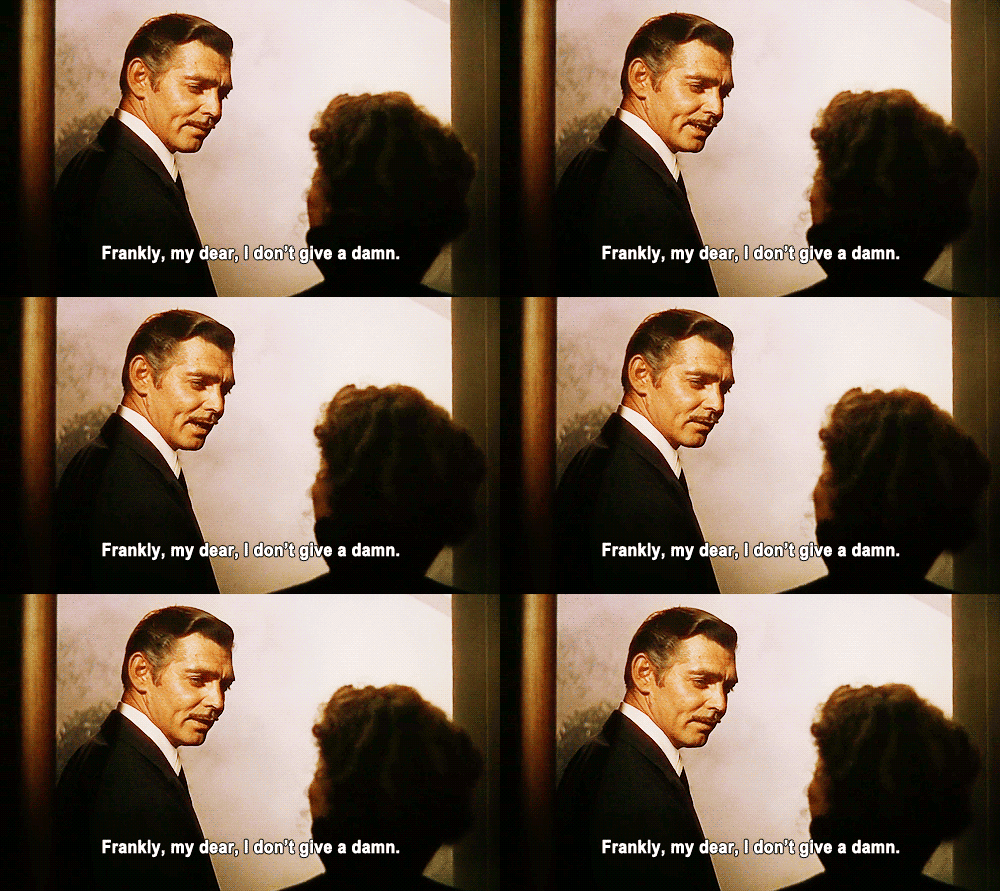
So long as you’re writing fairly present-day fiction, your characters shouldn’t always be speaking in full sentences or using ‘proper language.’ “Make sense?” (vs. “Does that make sense?”) Think about how you talk with other people. Do you use contractions? Do you leave out words that can be assumed? The answer is probably and usually, yes. So let your characters talk the same way and suddenly their dialogue will take on a much more believable tone.

2. Let profound statements happen, but not all of the time.
p&p
via giphy.com/wifflegif.com

Some of us (raising my hand here) tend to create characters with a streak of wisdom or flamboyance, and these characters like to speak up once and a while. But whether a character is offering advice or proclaiming his/her love, save profound and wordy dialogue for those rare memorable moments. Because let’s be real, no one talks like that very often.

3. Listen.
giphy (1).gif
via giphy.com

Often when we speak or listen to others talking, we’re only half present. We miss the nuances of language, the half sentences, the common and miraculous things that people say to one another.  Listening well is the first step to understanding how people really speak to one another, so you can insert it into your fiction.