Twitter Pitch Tips

Does writing a Twitter pitch make you feel like this?

file8831296040573

Yeah. It kind of exhausts me too. But here are a couple different things you can try to stimulate ideas.

The X meets Y Formula

Who doesn’t love blending two wonderful things into a new, even wonderfuller thing? It’s like the book version of slutty brownies (you know, the ones where you have the chocolate chip cookie layer and the brownie layer with a bonus Oreo layer in between?).

This is sometimes a cross between two books. Lisa McMann’s Unwanteds series is being sold as “Harry Potter meets Hunger Games” and that works for that book.

But a lot of my favorite pitches are more to the effect of one concept meets another. Example: My book is a zombie apocalypse, but in space. (45 characters) People like zombies and space, so why not both together?

But, this formula doesn’t work for all books. So let’s talk about some alternatives.

What’s Different?

Every pitch (regardless of length) you want to focus on the one most unique thing about it. This can be a unique feature of the plot, character, or setting (though I think setting is the hardest to pull off).

For my space zombie novel, I might specify how the character is unique: Cyn never liked her prosthetic leg. Until it saves her from being taken over by body-snatching parasites. (105 characters)

Or plot: Humans enjoyed exploring space until body-snatching parasites began exploring them. (83 characters)

Personally, I find the ones focusing on the uniqueness of the character are often my favorite.

Stakes

This generally takes the form of an if/then statement. Basically, though. What does the character stand to lose?

Example: If 17yo Cyn can’t stop the body-snatching parasites invading her ship, her friends may end up as alien puppets. (111 characters)

I will say I see a lot of “The world will end” sort of stakes. Not that those aren’t important stakes, but I like seeing more intimately how the main character will be affected. That’s why I chose to focus my tweet above on the friends rather than how actually all humanity would be screwed.

Voice

This is sort of a bonus thing, because it’s hard enough to get the basic information down, much less the voice. But if you can, great.  I think this is easiest with sort of sassy characters, but that I might just be because always write sassy characters (they can say things that I’m too polite to say).

Example: Body-snatching aliens are possessing all of Cyn’s friends. Jerks. (65 characters)

Genre and Age Group

Hopefully, this is somewhat clear just from the pitch. If you can say something like “17 yo Cyn” it’s implied that the story is YA, but if I have room I usually put that it’s YA (that’s only two characters).

“YA SciFi” is only 8 characters and would fit onto any of the example pitches with room leftover for whatever hash tag you need. I usually just tack it on to the end or the beginning.

I do try to stay away from abbreviations as they make the tweet seem less professional. But I don’t mind them for establishing age range and genre. PB, MG, and YA are fine. If you don’t specify, I usually assume it’s adult.

These example pitches aren’t perfect. Like I said, they’re from a random dream I had, and I sort of just came up with them on the spot. But hopefully they give you an idea of some of the possible directions you can take your Twitter pitch.

(originally posted on kyramnelson.com)


Editor’s note: These are great tips and examples from Kyra (who, if you didn’t know, interned at an agency and requested pitches—so she’s the most knowledgable of the MS Editors in terms of what agents like to see!) To see a diagnostic of these types of pitches in action, see Lara’s post on responses to her #SFFpit pitches.

Tell Me A Story

IMG_3885

When I was a little girl, my dad used to tell me stories. He’d make up lavish tales (that, later in life, I realized were all based off of Star Trek and Star Wars) about my sister and I saving the world, thwarting evil and destruction, and all before bedtime. They were brilliant stories. Stories of imagination and a life lived that was not my own.

Whether it was these stories or my primal love of all things books, I’ve grown into an adult with a secret fascination: I’m obsessed with stories. Books. Movies. Plays. Heck, even a good commercial. If it has a good story in it, then I’m in love. In fact, I have a very difficult time reading a book unless it has a good story in it (ask my friends—they get very tired of recapping awesome nonfiction books for me because, even though I think they sound brilliant, I just won’t read them). I need a beginning, middle, and end; I need a character I can root for, cry with, and relate to.

In fact, it’s stories that have taught me some major life lessons: I want to be strong like Furiosa and confident like Willowdean; I want to lead like Darrow, blaze trails like Puck, and love like Westley and Buttercup.

Stories are not only a fundamental part of our human history, but they’re, essentially, the only way we can understand someone else’s life. The only way we can learn about others’ experiences. To see from another’s perspective, to swap footwear.

I recently watched Still Alice, the beautiful film in which Julienne Moore won Best Actress in 2015 playing a woman with early onset Alzheimer’s. I avoided watching this movie for a year because it hit a little too close to home, and I knew watching the film would be a very emotional experience for me. But, when I was ready, I sat down and watched. And the story was unlike one I’d ever seen before. It gave me a tether, a sliver of understanding, of what it may be like for those diagnosed and—to the best of my ability—for those in my life affected by such a disease.

I recently listened to a podcast by The Liturgists that talks about just this. The hosts of the show spend a week at the Sundance Film Festival interviewing creators, artists, directors, and producers all exploring the same topic: why we tell stories. And while their topics of conversation varied over the course of the week, the same conclusion rang true: we tell to understand. Understand the world, understand ourselves, understand others.

If you’re here, then you’re likely a creator or producer of stories. You mold and guide and share stories. To understand. To proclaim a truth. To collectively be or experience something new, something wonderful, or something necessary. For justice, for love, for belief, for humanity. For oneness. For good.

So what is the purpose of this blog post? Why have I droned on about stories—besides the fact that I clearly have a problem? Sometimes I think it’s worth reminding ourselves that we have the power and the heart to make a difference in the world. To live in that which has the means to move and change.

Words build worlds.

So, go. Build.

Is good writing invisible?


Three years ago I wrote “7 Writing Maxims and What to Do with Them” on my blog, in which I take seven writing “rules” people throw around constantly and clear up what they actually mean and when to apply them.

Here are the maxims:

  1. Kill your darlings
  2. Show, don’t tell
  3. Write what you know
  4. Eliminate adverbs
  5. Avoid purple prose
  6. If you don’t have time to read, you don’t have time to write.
  7. Write with the door closed. Rewrite with the door open.

You’ve probably heard them all before. Go ahead and read what I have to say about them, but here’s an eighth maxim you might not have heard:

Good writing is invisible.

Here are some quotes and resources that say something similarly:

It’s my attempt to remain invisible, not distract the reader from the story with obvious writing. —Elmore Leonard

A mature artist never calls attention to himself, and a wise artist never does anything merely because it breaks convention.—Robert McKee

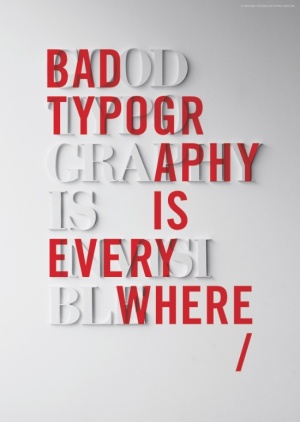
Maybe writing is like typography:

bad-typography-is-everywhere-good-typography-is-invisible-prints

Bad typography is everywhere. Good typography is invisible.—Craig Ward

Good writing is invisible…is it really?

You know what’s invisible?

Cliches. Nobody even remembers where they came from anymore because everybody uses them. They are the obvious, hive-mind choice.

Formal writing. When you’re taught how to write a paper or conduct professional correspondence, you’re learning academic or formal writing. Formal writing is a style of writing that is, by nature, anonymous. It is so far removed from personality, that passive voice is almost encouraged. (What’s passive voice? I just used it. “passive voice is encouraged” … by whom? Passive voice removes the active subject from the sentence. Rewritten, that sentence would be “Academics almost encourage…” or “Formal English usage almost encourages passive voice.”)

Creative writing is the opposite of formal writing. “VOICE” is the buzzword we often hear as writers. What’s my writing voice? How do I know if I have it? How do I create or establish or develop it?

Your voice is your personality. Every time you choose imagery or vocabulary, you are creating your voice. Every time you decide between using a comma, semicolon, period, or dash, you’re making voice choices. If you’re writing in first person, every word and simile or metaphor your narrator makes establishes that character’s voice.

Good voice is specific and interesting. It’s remarkable. If something is remarkable, it’s not invisible—otherwise it would be unremarkable, like dry text that doesn’t excite or compel the reader at all.

But you can swing to the opposite side of the spectrum, and that’s not good either. Bad writing is certainly “remarkable”—people talk about how bad it is. Now, maybe you think all press is good press. That’s true to a point. I’ve definitely read books and watched movies knowing they’d be bad, reveling in their awfulness.

So we’ve got completely “invisible” text on one side, the text people don’t even want to look at because it has zero personality. On the other side, we have hyper-“visible” text: gaudy, self-obsessed writing that draws attention to itself. This is the purple writing, the “Look at how clever I, the writer, am” writing.

If you have to err on one side, then go toward gaudy. Garish writing is easier for editors to tone down than lifeless writing is to animate. It’s easier for me to say, “Oh, hey, these metaphors your exposition is wearing clash with each other. Let’s take one away or rewrite it.” or “Maybe this description of your narrator needs a trim.” than for me to play Doctor Frankenstein and use questionable science ghostwriting bring your text to life.

Get an honest—not cruel, but not “too nice to tell you”—critique partner to tell you if your writing style feels too formal or academic or if it is a little too loud and loose.

  • If your writing is too formal, then read more contemporary fiction and poetry. Allow yourself to play. Write like a madman. Take a creative writing or improv class. Find your cliches and rewrite them to be fresh and personal to your narrator.
  • If your writing is too loose, ask critique partners or beta readers where you went too far and listen to where multiple feedback aligns. Make sure you’re using punctuation correctly and not too liberally. Ask yourself if you use metaphors or similes too often and if they are appropriate for your character’s worldview and experiences.

Good writing is visible. It’s the writer that should be invisible. Look back at the quotes from writers above. It’s the writer, the artist, who is invisible, not the writing itself.

Readers should be so immersed in your story, they won’t be constantly reminded of who brought them there. It’s your job as a writer to create experiences and emotions in your reader. It’s not your job to impress or annoy. You won’t be standing over their shoulder saying, “Do you like that metaphor there? I’m pretty proud of it. I came up with the idea when I was yadda yadda yadda.” You won’t be chucking semicolons and em-dashes at them saying “DON’T YOU FORGET ABOUT ME.”

But when they stop reading and want to go on their next trip, then they’ll remember you and come back to you for more.


The same goes for pitching your novel—your story is more important than who you are or how or why you wrote it. I’m leading a pitching workshop starting on June 8th. Join at any time! For information on how you can save $50 or even win free tuition, check out this post on StoryCadet.com


Did you enjoy this post? Please share it with other writer friends!
Click to Tweet: How to strengthen voice (or know if you’re overdoing it) by @LaraEdits: http://ctt.ec/7T49C+

On Writing “True” Fiction

Writing Truth

Fiction is a lie, and good fiction is the truth inside the lie – Stephen King

I believe that one of the most difficult tasks to master when writing fiction is to write truth.

Fiction must have more of a ring of truth to its words than nonfiction often does, because as Mark Twain so expertly articulated, “Truth is stranger than fiction, but it is because fiction is obliged to stick to possibilities; Truth isn’t.”

I don’t pretend to have the recipe for writing what is both true and fictitious, but being a new mom has me stumbling on some new realizations about my own writing and writing in general.

I’ll share what I’ve been learning and would love to hear what you think makes fiction writing ring true in the comments.

Writing truth comes from a place of humility.

Writing as if you have some deep insight on life or even your character’s psyche doesn’t ring as true as approaching subjects and characters with humility. The willingness to accept the mystery in this world, the finite nature of humanity, even your own limitations can infuse your writing with unforgettable characters and moments of profound insight on life.

It’s organic. 

Writing is very much a discipline, but I still believe the truest writing can’t be coerced. The best and truest writing must still flow from a place of conviction, experience and acceptance of what we’ve been given to write.

It’s not all “wrapped up”

In 6th grade, I entered a local writing contest and was invited to a luncheon with a local author. The guest author who evaluated our stories said that my story was good, but the ending was too “wrapped up.” It was the first time I realized that good fiction always has some fraying strands because life is never perfectly wrapped up either.