Tips for Self-editing

Even if you plan to hire an editor, it’s a good idea to edit your own work as much as possible. That said, it can be hard to edit your own work. Especially when you feel like you’ve been working on it so long that it your eyes seem to glaze over at the mere mention of it. Today I want to give you some practical tips for getting through edits.

  • Give it time. I find I pretty much always need to let a project sit for awhile before doing serious revisions. Give your brain a little time to forget some of the details so that it doesn’t just gloss over them while reading.
  • Change the font. I’m alway surprised by how effective this is in tricking my brain into thinking that I haven’t read the page a hundred times before. It’s subtle, but I’ve found it useful.
  • Print it out. I think everyone has had that experience where they notice a typo as soon as they print out a paper or hit send on an email. I don’t know why this happens, but you can use it to your advantage. Like changing the font, looking at a printed page will help your brain see the work in a fresh light.
  • Go through it backwards. This is something I suggest if you’ve made it to the line-editing stage of revisions. Start with your last sentence and then work your way to the beginning. This forces your brain to focus on the flow of individual sentences, rather than the story at large.
  • Vary your reading speed. I think sometimes it’s really helpful to go through the manuscript really slowly. Other times I like going through really fast. I notice different things depending on how fast I read.
  • Change your environment. This may be as simple as moving from your living room couch to your kitchen table. Just switch things up a little bit so that your brain is forced to pay more attention.
  • Read it out loud. Or have somebody else read it out loud, if you can. Listen to which parts make you stumble. Those are your problem areas.
  • Edit for somebody else. You’re more objective when editing for other people. Look at strengths and weaknesses in their writing. Then compare it to your writing. Are you struggling with the same things. Or are they really good at something you have a hard time with? Learn from them.
  • Refine your process. The more you edit, the more you know what works for you. You’ll get better the more you do it.

creative-108545_1280

What editing tricks have worked for you? Share in the comments!

Stop and Save

FullSizeRender 5

Warning: This post is silly.

Earlier this month, I had the immense honor of attending the first ever NerdCon: Stories—a two day writing conference in Minneapolis, Minnesota featuring some of my favorite, young adult writers.

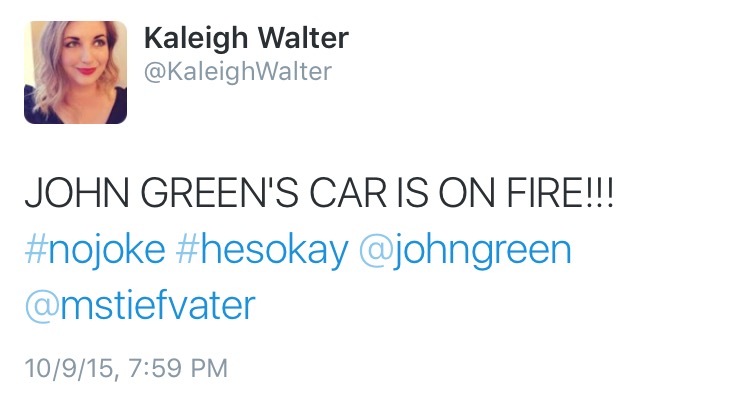
There were panels, there were signings, there were famous authors reading their adolescent and angst-filled stories and poems, and there were drag races. Yes, drag races where our beloved John Green caught fire! If you don’t believe me, see my tweet (pictured) or Google because it happened.

And, while I was watching John Green’s car burn (twice), I thought, It’s a good thing he saves his work*. Let me rewind the day’s events.

Earlier that afternoon, I sat in on the “Nerdfighter Q&A” panel featuring John Green, his brother, Hank Green, and the hilarious and intelligent Maureen Johnson as their moderator. Between laughs and John locking Hank out of his own iPhone, brother-style, an audience member asked how Hank’s book was coming along, and he replied (and I paraphrase), “It’s going well. That is, if I can get the book off my broken laptop.”

“Wait,” Paraphrased-Maureen-and-John said, aghast, “you didn’t back up your book?”

That’s right, folks. Hank Green—the Internet mogul, video blogger, curator of NerdCon, brother of very famous writer, general man of mystery—didn’t save his work.

To be fair to Mr. Green, he was writing using writing software; however, he didn’t back up said software.

Luckily for Hank and the world, it looks like he’ll be able to retrieve the book from the incapable laptop with the help of geniuses. Yet, I think there is a lesson here, and that lesson is simple: Save your work.

Personally, I thought this was a very obvious thing that everyone knew in 2015, but if a man who shares DNA with John Green forgot to do it, perhaps there are others out there making the same mistake.

So, how do you save your work? No, I’m not going to talk you through how to save a file (Step one: click the floppy disk; Step two: if you don’t know what a floppy disk is, Google). Instead, I’m going to link to a slew of programs and tools for writers to help you write and save your work. And then I’m going to remind you to back up your files, so consider yourself reminded.

I would provide a lesson on these tools, but that would make me a total hypocrite, as I don’t use them. I’m super old fashioned; I still use Microsoft Word and save the docs to my email. But before you judge, know this: THIS IS EXACTLY WHAT JOHN GREEN DOES (he said so in the panel), and any comparison to John Green is just fine with me.

So, happy writing, friends. But more importantly, happy saving.


*Actual thoughts were: 1) He can’t die! He’s got too much writing left in him! 2) WAIT, DOES HE KNOW HE’S ON FIRE?! 3) Some curse words I can’t say on this blog because wholesomeness.

5 Tips for a Great Relationship with Your Freelance Editor

reaching outSo you’ve decided to work with a freelance editor on your book. Congratulations on taking the leap! If all goes well, you’ll wind up with not only a stronger manuscript and cleaner writing but also with a long-term partner for your current and future projects.

How do you make sure all goes well? Even if you’ve checked the editor’s experience, abilities, and compatibility for your project, how can you take that relationship from good to great? While relationships are two-sided and will also require some effort on the editor’s part, there are several constructive things you can do as you interact with your editor.

  1. Understand the terms ahead of time.

Misunderstandings are a huge strain on the writer-editor relationship, so do your part to make sure they don’t happen. Read the editor’s website and contract carefully before entering into an agreement. If they say something is required, it’s required. If they don’t say they’ll do specific tasks for you, like ghostwriting or formatting, that means they probably don’t do those parts of the process.

Don’t be afraid to ask questions ahead of time to make sure you’re on the same page. Your editor will be happy to clarify their policies, and you’ll get the chance to ask for your specific needs to be met and make sure they’re possible and expected.

  1. If you need more work done, pay more.

At the beginning of the editing job, you and your editor will agree on a specific price for a specific amount of work, whether that’s an hourly or flat rate. If, after the editor completes the work, you decide you need a little more advice or edits of updated portions of the book, don’t ask them to work pro bono on those extra hours. Some editors will allow for multiple rounds of revision or coaching, but remember point #1: you need to make sure it’s in the terms of your agreement ahead of time.

A good editor loves their job and wants to give you the best possible value on the work you’re paying them to do. Don’t stress them out by forcing them to choose between having to tell you “no” and losing work time that they could have put on the clock elsewhere.

  1. Trust your editor’s advice.

Ideally, you took the time to check out your editor’s credentials before you hired them. Do they have proper training and knowledge to help develop your book? Do they understand grammar, punctuation, and the specifics of a style manual well enough to give you a quality copyedit? Did you talk with them about your project and get a sample edit done to make sure they can deliver what they said they’ll deliver? If so, trust that they know what they’re doing.

One of the more frustrating things that happens to an editor is that an author hires them to improve their book and then doesn’t let them actually improve it. If your editor says the organization of your chapters isn’t clear, don’t tell them it’s “good enough” just because you don’t want to change it. Ask questions. Learn. Understand what they see, and then decide how to make use of it. In the same way, if you know they understand their style manual, don’t flip out at their corrections of your comma usage or parallelism. If something sounds strange, ask—a good editor will be able to point you to the rules they’re following.

You hired this editor because you believe they’re an expert; trust them to truly be that expert.

  1. Don’t make demands.

You retain all rights to your book; your editor retains all rights to their own time and processes. You’re coming to them as a client, not as an employer, so what you’re paying for is a service, not the right to be their boss. If there is a certain way you would like things done, it’s important to—you guessed it—mention it ahead of time! Good freelance editors are a friendly, helpful bunch on the whole, so there’s a fair chance they can work it in.

If they tell you “no” because something you’re hoping for goes against their policies or procedures, don’t conclude that they’re being unreasonable. They’re just doing what’s best for their business and clients as a whole, and a client who tells them how to do what they do isn’t going to help anything—or get any results. If it’s vital to you to find an editor who will chat via phone or edit using a specific program, don’t get upset at the ones who don’t—they’re not doing anything wrong. Simply look for one who does.

  1. Share your vision.

Why does your editor do what they do? If you’re not sure, ask them—they’ll likely be excited to share their passion. What you’ll discover in most good freelancers is a love for story and language and a commitment to come alongside authors to make their work the best it can be.

We want to partner with you! As you begin a job with an editor, whether they’re coaching you on your story or copyediting your late draft, share your vision. Tell your editor why you’re writing what you’re writing, what excites you about it, and how you picture the end result. Your love for and your commitment to your project will be contagious, and once your editor catches that vision and excitement, your book will have gained a partner for life.

It’s a relationship.

The way a writer and their editor interact is a relationship, and like all relationships, a strong one takes time and effort. When you put the time into sharing your vision, respecting your editor’s time and knowledge, and double-checking expectations ahead of time, that effort won’t go unnoticed.

As a freelance editor, if I see you acting that way as a writer, I’m going to return your respect and commitment to this partnership. I will answer your questions, get excited about your book, cut no corners in the advice and corrections I give you, and do my best to make the process smooth and convenient for you.

Your book is your baby, and a good editor is going to come alongside you to help it grow into a strong, healthy manuscript. To build up the writer-editor relationship from good to great, encourage an environment of trust and respect by implementing the five tips above. Your editor, if they’re worth anything at all, will reciprocate with their own time and attention. There will be much less stress in the process, and both you and your editor will be happier and healthier for it.

handshake

Elements of Poetry You Can (And Should!) Adopt in Your Writing

Fall gets us all dreaming again, but it also brings us back to the basics.  I loved what the other editors had to say about transitioning this fall and making time to write, remembering the importance of voice and the “class rules” of publishing.

When I think about this season of intense beauty and rapid change, I think of poetry. To me, there is no season so poetic as autumn. There is death, change and beauty all at once. And, of couProcessed with VSCOcam with f2 presetrse, there are pumpkin drinks. 🙂

Now, let me be honest. A lot of poetry goes way over my head. I much prefer short stories, novels, even articles (at times) to poetry. But there are elements of this mysterious art that are absolutely essential to good manuscript writing–elements that are often missing from stories altogether.

Take a moment to look over these poetic elements to see if they are a part of your manuscript. If they’re not, don’t let your story sit another minute without them!

3 Elements of Poetry You Should Adopt

Sensory details/images — As MS writers, it’s easy to describe the way a place, person or object looks. However, we often leave out smells, sounds and touch. These other sensory details can really ground a moment in your story, make it unforgettable and even experiential for a reader. Do your descriptions make a reader smile, grimace, cover their mouth, even plug their noise? Watch someone read your writing; you’ll know whether or not you’re using great sensory details.

Metaphor— So many writers try to just kind of tip-toe by with a few lame metaphors. They might throw in a cliché simile once and a while, but good metaphor goes beyond “her hair was black as night.” Metaphor shouldn’t just link two similar things. At times, it should link two very diverse things. Sometimes it should surprise a reader; it should be visceral, memorable and unique. It might even link two different senses.

Pacing (Rhythm)— Good rhythm is essential in any poem, but it is also a key element of good story writing. Rhythm, or pacing as I prefer to call it, comes into play almost everywhere. Read aloud to see how quickly or slowly your dialogue is moving. Pay attention to the punctuation and physical space you use to slow down or pick up speed in a scene. Good pacing will be the difference between heart-quickening rising action and a climax that practically goes unnoticed.

How do you adopt said elements?

First, read. The best way to keep these elements in your writing is to put yourself around them. Find writers who clearly use these elements throughout their stories. Better yet, read poetry. Even if you don’t get it, you’re introducing yourself to new words, crazy (sometimes powerful) metaphor and carefully crafted pacing.

Second, scribble. Write down lines, metaphors and images that come to your mind throughout the day. If you’re driving and inspiration strikes, make a quick voice recording. Don’t let those moments slip by! If you come back to it and it’s garbage, no worries. It’s about putting poetic thinking/scribbling into your every day.