When I was eighteen, I wrote a story (and I use the word “story” very loosely because it was extended fan fiction). After my homework was done and while my entire dorm slept, I spent the wee hours of seven months writing an epic “story” the size of a large novella. And I loved every second of it.
In fact, while I now shudder at said content (as most writers do when reading their old material), I remain eternally grateful to that story as it taught me some very important lessons, one of which, I’m sharing with you today.
The Play-By-Play
In my experience, new writers often write too much. I am one of those writers who sees my scene like a movie sequence, and so when trying to covert that scene onto the page, the end result is literally every single character movement. My fanfic was 40,000+ words, and I only had one break in the time sequence, and it was when the characters were sleeping. The story took place over the course of twelve hours, and I gratuitously translated every second of those hours into verse: “I did this, I did that, I stood here, I breathed there, I moved my arm, I shuffled my feet, I gasped in alarm, I cried, and then I breathed some more.”
While scene descriptions, character quirks, and action details make the best stories real and alive, I believe there is a point when the literal “play-by-play” can distract from the scene instead of add to it. This sounds rudimentary, but I see this in writing all the time, including in published books. A scene that should take three well-crafted sentences takes a whole page.
So I challenge all new writers working on a scene to ask: is there any benefit for their reader to know this? Maybe. Perhaps the scene establishes setting, explores the character’s personality or flaws, etc. But do the readers need to see the character wake up, take a shower, put on some shoes, eat some Pop-Tarts, catch the bus, trip up the front steps, grab the books from his locker, and go to English class where he realizes he left his paper at home?
In my pretend story, the real action begins when our young hero realizes he forgot his paper because that scene introduces the conflict. Unless our protagonist had a fight with his mom or saw his crush on the bus (both introduce plot), the readers don’t need to know every detail of his morning.
The “play-by-play” was how I learned how to interact with my stories. I see my character from the very beginning to the very end, and I record every step in between. It’s still the way I see my stories. But as writers, we must decide which steps establish setting, conflict, theme, and character development. The writer may know the protagonist’s favorite breakfast cereal, but the readers don’t necessarily need to.
And please, let me be very clear here: this writing style is by no means a bad thing. I don’t believe any style of writing is “bad.” If you are writing and creating stories, you are participating in something that I believe is good and beautiful. However, this writing style could occasionally benefit from editing, whether that’s by you or someone else.
So while creating your story, remember it’s okay to skip pieces of the “play-by-play.” Instead, include only what is vital to the story. No more, no less.
Last week I heard about a project called “Immerse or Die.” It’s a rating system for books—when we are immersed in a story, we keep reading. When we are taken out of the story, we are more likely to abandon the book.
How do you keep your reader immersed in the story? Pay attention to how you are describing your world. (Originally posted on my blog Write, Edit, Repeat)
In today’s post, I talk about stage directions in fiction, writing natural descriptions, why some books are constantly reread by readers, and, to an extent, immortality.
Orderly Description
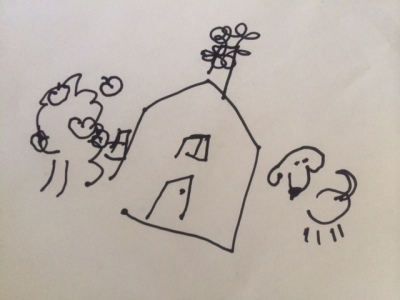
Ever played that “blind drawing” party game? You close your eyes or put a piece of paper on your head and someone gives you direction upon direction to cram into one picture?
Here’s an example for the party planning website Sophie’s World (which, consequently, is the title of one of my favorite books):
“I’d like you to draw the outline of a house. Just a simple little house, right in the middle of the page… Now, beside the house I’d like you to add a tree, a medium sized tree, not too big, not too small… Oh, I forgot! You need a front door on your house. Please draw a front door so that the people can come in and out easily… Oh, did I tell you there are apples in your tree? Draw a few apples, maybe 5 or 6, in your tree now… And don’t forget the windows in the house! I think two would be nice… Did I remind you to draw a chimney? Let’s put a chimney on the house, with some smoke coming out the top… Oh, and look! There’s a dog in the yard… And a picket fence… And of course there’s a family…”
This is the kind of experience a reader has when you describe something in an unnatural order:
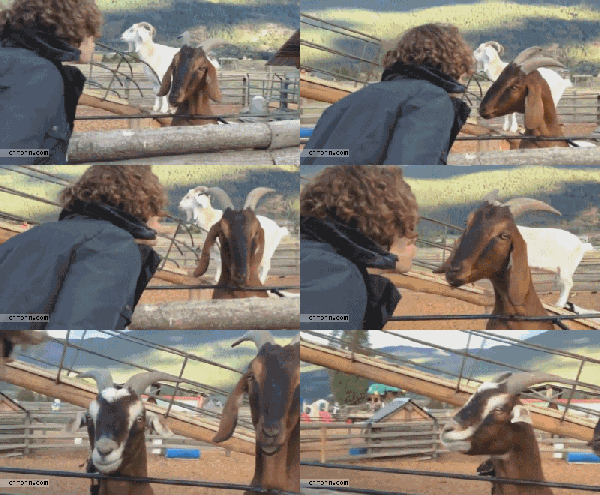
It’s also what it’s like when description is given out of order. When describing a scene, consider camera shots. Zoom in from broad descriptions, ending on one specific detail. Or zoom out, starting on a detail and working your way out to observing the whole. Pan in one direction. Going in an unnatural order gives the nauseating effect of “shaky cam.” Adding details too late, after the reader has already created the image in his or her mind, gives what I like to call the “awkward goat” effect, after this GIF:
Writer: “I went to give the goat a kiss. Then the other goat—” Reader: “Wait, there’s another goat?” Goat: “SURPRISE! I’ve been here the whole time!” (maniacal goat bleating)
Another problem of ineffective description is overcomplicated stage directions. I see sentences like this all the time in unpublished manuscripts:
“Come with me,” he said and turned around while kissing my hand as we ran away together.
Though these are most often found in dialogue tags, I see overcomplicated stage directions all over. That sentence above is just one I made up, but let’s rewrite it so it doesn’t seem like “he” is doing a hundred things at once.
First, find the perps: “and,” “as,” and “while.” The two latter words can often be cut in stage directions. The former is a fine word that sometimes gets overused. Let’s focus on no more than two actions at once.
Said + turned, kissing + ran
“Come with me,” he said, turning around. He kissed my hand, inviting me to run away with him.
What did I just do? I took advantage of my friend the progressive verb.
A progressive verb is a verb ending in -ing. That ending tells us that the -ing verb is happening while something else is going on, while letting us cut the “while” or “as.”
“While” and “as” aren’t bad words. It’s not about the word, it’s how you use it. By all means, use “as” to make a simile (e.g., “as [adjective] as a [noun]”). “While” is an innocent preposition until proven guilty. The problem is using them to show more than one thing happening concurrently. Show me a manuscript which uses “while” or “as” in the first page in stage directions, and there’s a big chance that same construction will keep showing up over the next ten pages.
Doing a find/replace search for all instances of “as I,” “as we,” “as she,” “as he” (depending on your POV), repeating the search with “while,” will help you see if you’re going overboard. Use them a few times, and that’s fine. Do it a few times per chapter, and you’re just being unnecessarily wordy. Gone are the days when novelists are paid by the word.
The Divine Detail
Remember, your novel has to compete with online, in-demand television and movies. You need to keep your reader’s attention. That doesn’t mean your novel needs explosions or murders every other chapter; it means your prose needs to be immediate and precise rather than longwinded and wordy. You want to be Robin Williams giving his Seize the Day speech, not Ben Stein droning about economics. The difference isn’t just subject, it’s diction. Do diction right, and you’ll engage readers that otherwise don’t care one iota about your subject. That is, until they start reading your book.
When describing, choose one or two vivid details, referred to by editors as “divine details” that can set the scene or characterize, and let the reader fill in the rest of the image. Compare the chaos of the drawing above (ain’t I an artiste?) with expansion drawings done by children:
Image via ArtMommie. Click for more images.
When the reader is allowed to contribute, your work takes on a new form. It evolves in the readers’ individual minds. It’s a spark which they build upon to create a conflagration.
Letting the Reader In
It doesn’t matter how brilliant of a writer you are—writing and reading are collaborative efforts, and that collaborative effort will bring more life and beauty to your work than you could hope to do by yourself.
Sometimes we write because we’re control freaks. We are the masters of the universe, and we will plot and plan and tell our characters exactly what they should do. But when we let our characters breathe and give them freedom, when we let the reader have some creative liberty, our work takes on a life of its own.
Maybe that’s a cliche, but if you want your work to live on after you’re gone, you need to let your reader experience your world naturally. You need to let them read between the lines and contribute to the meaning and world of your fiction. When you let them participate, readers will not only want to buy your books, they will want to reread your books over and over again, letting them become part of their life, seeing how their interpretations change over the years.
At the beginning of the month, I posted a three-part series of “Revision Cheat Sheets” over at ElizabethBuege.com. The first post in the series deals with revising your manuscript for structural elements, and the third post deals with addressing grammar and style on the sentence level. The second cheat sheet, which talks about revising your scenes, was the most popular, so it’s the one that I am reblogging here today. Happy revising!
It’s best to revise your manuscript for structural elements like characterization, conflict, and plot before moving on to scene revisions, so I’m assuming in this post that you’ve already done some developmental work on your novel and are ready for a second round of revisions. Today’s cheat sheet deals with the content, descriptions, and dialogue of your novel’s scenes.
Scenes are where the reader connects with your story.
You might have planned extremely convincing characters with equally convincing conflicts for your novel, but unless you can let the reader into the story, they won’t be able to connect with it. Your whole story should not be made up out of summaries, but neither should you write your entire book in meticulously-described scenes with no summary or reflection. Scenes are like little snapshots into your characters’ experiences, and it’s your job as a writer to make sure you use this tool effectively. During your second round of revisions, it’s time to take a closer look at your scenes to make sure you’re including the right content, giving relevant descriptions, and using dialogue well. Continue reading Editing Scenes (from Elizabeth’s Revision Cheat Sheets)
Recently I wrote an article for a client on how creatives get their ‘ creative juices flowing.’ (It’s in the editing queue or I would totally link to it). In order to get some insights, I posed a question on HARO, and within a day my inbox was flooded. Writers, designers, illustrators, and craftspeople were all full of ideas on how to make ideas happen and get creative.
As I began to leaf through their responses, something struck me: each of these individuals has his or her own creative process.
All of them have a way in which they go about starting, sustaining and finishing a project. A few people even described their creative process to me, with others just highlighting a phase or step they take when creating.
Then I realized something else: I was not familiar with my own creative process.
As someone who’s been writing and drawing since learning how to hold a pencil, you’d think I’d have a hint by now. Nope. Thinking about how I create feels like closing my eyes and trying to picture my face. Strange.
If you’re like me, your creative process may be a bit of a mystery to you; it may feel strange to try and capture it and duplicate it later. But I’m convinced that unlocking my (your) process is the key to understanding how to improve both the process and the final result.
The first step to unlocking your creative process is to simply understand the components of creating. I’ve listed what I believe to be the four main phases of the creative process. (I’m sure there’s zillions of opinions and ideas about what the creative process actually includes, so keep in mind, that this is just my take.)
With each phase, I’ve listed a few questions you can ask yourself to better understand your personal process and start thinking about ways to improve it.
1. Ideation Everything starts with an idea. Ideation may happen when you’re lying awake in bed, going for a long walk outside or taking a shower. It’s different for everyone, so the key to this step is finding out what starts your idea engine and making time for that activity.
Ask yourself: where and when does ideation happen for me? * Do I carve out (enough) time to do the activities that bring me ideas?
*If you can’t think of any specific times/places that ideas happen, you may want to start trying some different brainstorming techniques to see which works for you
For me, spending time riding my bike or walking in nature is what inspires ideation.
2. Invention (Creating)
This is the phase when you actually start to put the pen to paper, fingers in the clay, a brush to canvas. Actually starting can be the most difficult (and longest) step in the process. As you think through your creative process, you may have several sub-steps* that fall under invention in order to get you all the way through to the next phase.
Ask yourself: what holds me back from starting to invent/create? Where do I do my best inventing/creating? Do I have (enough) time carved out to invent/create?
*planning, organizing, outlining…
3. Reflection
This is the phase in your process when you look back at your work to reflect and evaluate. For writers, this is asking someone to read your work, going to a beta-reader or hiring an editor. This is also self-reflection, thinking through and assessing your creative process and your finished project. This step is often ignored and can be the scariest part of the creative process. It’s hard to think about our work objectively and face the flaws, but ignoring the reflecting phase is as silly as denying the fact you have a hammer in your house. This phase is a powerful tool that allows us to hone our craft and improve our process.
Ask yourself: Do I actually reflect? If so, do I use reflecting to improve my finished product? Do I have (enough) time carved out for reflecting?
4. Re-inventing
The final* phase in the creative process is reinventing (re-crafting, or recreating). Often after reflecting, we can feel overwhelmed or sick of our project and give up on or ignore it for a time. Getting to the point where we are actually willing to reinvent can be difficult, but is absolutely key to accomplishing our creative process. Reinventing is the place where we take what we learned in reflection and improve upon what we’ve created. Though the name I chose for this phase might suggest a total over-haul, that is not the intent. The reinventing stage is to simply re-visit what you’ve made and make improvements.
Ask yourself: Do I allow myself to reach this step? What is hard for me about this step and how can I remove these barriers? Do I have (enough) time carved out to recreate?
*We may go through several rounds of reflection and reinventing before we finally “finish” with a final round of reflecting.
Now what
Now that you know the components of most creative processes, it’s time to map out what it takes you to make and carve out time for each phase. More on how to map out time to create in posts to come…
For the comments: How do you create? I’d love to hear your thoughts and ideas about your own creative process and what makes it work!