At the heart of everything, I am a writer. And to be a writer is to, at times, struggle.
I certainly know what it’s like to struggle. To fight for each word that appears on the waiting page. To suffer from writer’s block, self-doubt, fear, and fatigue.
My biggest mountain lately is time. I have none. And in the time I do have, my brain tends to be very mushy and useless.
I’ve heard from countless writers that it’s important to write every day. And I wholeheartedly agree…in a perfect world.
So, you ask, how have I mastered the art of writing and time management? Simple. I haven’t. Not even close. But that doesn’t mean I give myself permission to stop trying. Here’s my motto: anything is better than nothing, and routine is better than anything.
My advice: be realistic, start small, and stick to it.
My current writing goal is to sit down at my computer and create something at least twice a week. Yes, only twice a week. Why twice? Because it’s all I think I can manage. And that’s okay because it still allows me to create. I’m still working, still plugging away every week.
So develop a schedule, something that works for you, that inspires you, and that won’t make your brain mushy. And keep going back. A little bit at a time. It’s worth it.
Some people write like they mow lawns. They start at one side, and when they get to the other end, they’re done. They wait a few weeks, then comb through it again.
I’m more like a gardener when I write. Planting seeds, weeding, transplanting, watering, planting more seeds, pruning, harvesting.
I’m not a very good gardener. I have a board on Pinterest called “Gardening for the Bewildered” which makes me feel like I’m actually making an effort without actually making any effort.
We can read all the books about gardening we want, we can watch other people mow their own lawns, but we’ll never get anything finished if we don’t start.
I’m all about planning out my writing, but sometimes I get to the planning stage, I plan for a while, and then I stop. But planning isn’t actually writing.
I read a great blog this week by Laini Taylor in which she talks about exploratory drafts. Not first drafts, exploratory drafts. It’s a great read.
I devoured Understanding Comics the other day and I cannot wait to share some of the things I learned about the journey of artists. Except I can wait, because that deserves its own post!
Today I took out a scene on which I’ve been stumped for a while. Reading my notes from Understanding Comics helped, since I’m writing a graphic novel, but I still never would have finished the scene if I hadn’t thought about all of the possibilities and explored some of them through writing. It was exploratory drafting, and I got through it.
Are you writing or exploring? Are you filling up your creative tank? Are you blocked?
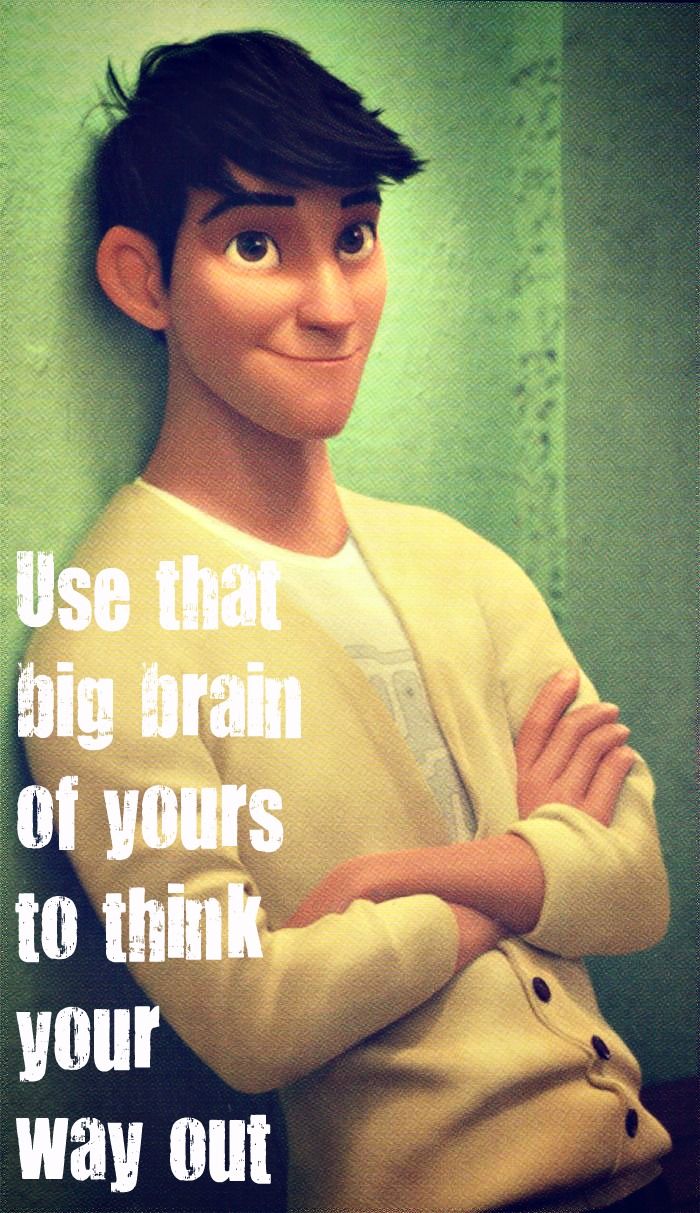
If the latter, listen to Tadashi:
The character and appearance of Tadashi belong to Disney Animation
You just finished writing the last page of your story—congratulations! Whether you pumped out a NaNoWriMo victory or spent the last five years agonizing over your dream book, you now have a full manuscript sitting in front of you. Give yourself a pat on the back; you deserve it for making it to the end. Now what? You want to make your story better, but you’re still too close to see its weaknesses and discern whether readers would enjoy it. It’s time to get an outside opinion. If you take your work seriously, you should show your story to someone other than your mother or best friend. Run far away from anyone who has an obligation to tell you that your story is great as is! No book will be ready for publication without major revisions, so you need to hook up with someone who can give you informed feedback on what to fix. Most writers turn to one of two people: a beta reader or a profession editor. What’s the difference between the two? When should you pay to have an editor provide a manuscript critique, and when is it smarter to stick with a beta reader? No single answer fits every writer, so here are some guidelines to keep in mind.
A beta reader knows books and agrees to read and react to your story.
A beta reader…
…is usually someone you know well or trust.
…is often another writer but sometimes just an educated reader.
…must not be afraid to be honest.
…is unpaid, though writers often exchange reading favors.
…reacts to the story as a reader.
…typically doesn’t check grammar.
…may comment on characterization, dialogue, and pacing if you ask them to.
The primary job of a beta reader is to let you know what a reader would think of your book. A good beta reader will tell you what they liked about your book but will also point out anything that they found confusing, unbelievable, or dull. Because personal tastes vary, it’s a good idea to get two or three reliable opinions when working with beta readers.
An editor is paid to shape stories into books and will give specific, structured feedback.
An editor…
…is a trained professional, often someone you don’t know.
…has an eye for what readers want as well as for the standard of quality writing.
…knows the elements of good writing well enough to tell you not only where your writing is strong or weak but exactly why it is that way.
…knows your genre well enough to make sure your book fits its context well.
…gives you, after a careful reading, a multi-page analysis of major story elements—characterization, dialogue, plot, pacing, continuity, style, etc.
…recognizes and notes consistent issues with your style and grammar in a constructive way.
There is a time and a place for both beta readers and professional critiques.
Without knowing you, I can’t tell you which option is best for your situation. Take a close, honest look at your goals, experience, and resources. Then, make your choice with these scenarios in mind. Use a beta reader…
…when an established fellow writer is willing to trade manuscripts with you.
…when an acquaintance you trust has a good eye for story and style.
…when you’re on a tight budget and want to know what to improve on your own.
…when you’re looking for readers’ reactions before or after you self-edit.
Use a professional editor…
…when none of your acquaintances have the experience or knowledge to give your manuscript a thorough, quality critique.
…when you’re an unestablished author and aren’t sure what to do after your first draft.
…when you doubt your own editing skills and want your repeated mistakes pointed out.
…when you want a professional opinion before you pursue publishing.
…when you’re planning to self-publish and won’t have an agent or publisher to advise you on the shape of your story.
…when you have the budget to push your writing to the next level.
Being good at storytelling and grammar doesn’t mean that you won’t need help with your book.
I should know—I’ve had training and experience in writing style, advanced grammar and syntax, and the shaping of stories, but I still miss problems with my own writing. Even though I’m a trained editor, I still plan to get outside help when I get a little farther along in my fiction manuscripts. Depending on my budget, I might decide to fall back on some trusted beta readers who graduated from the same writing program as I did. Whether I work solely with the beta readers or also turn to a professional for a manuscript critique, I know that solid feedback is a crucial step on the road to a finished book. Do you suspect that you want a professional manuscript critique? Talk to me—I’m happy to chat about my process as an editor and take a peek at your first chapter. If I’m booked out or don’t work in your genre, I’ll do my best to connect you with another experienced professional who would be a great fit for your story. Is working with beta readers a better option for your situation? Follow the blog—I’ll soon be posting tips on finding and working with a great reader.
Comment below if you’ve worked with a great editor or beta reader in the past; other readers and I would love to hear about your experience, and your critic will thank you for the praise!
I recently spoke with an aspiring author who had been hearing a lot of criticism about her manuscript. To the critics, her plot just wasn’t believable, her character was too well-adjusted. This is not an uncommon phenomenon. As aspiring authors, we all have to undergo a vast amount of critique (even self-critique) to wade through our first MS.
But even well-known authors—the published, famous ones—have probably seen the internet rants of critics calling their work “sub-par,” “elementary,” “contrived.”
It stinks, but in some form or other, criticism will be part of our writing experience. So instead of running from it, we need to find some ways to cope and even use this criticism to our advantage.
3 ways to cope
1. Don’t take yourself (or your work) so seriously. No matter how artful and ethereal your poetry is, no matter how well-rounded your character, you are still a human being that shares earth and oxygen with the rest of us; therefore, you are fair game to be criticized.
I found this “critique” in a favorite zine of mine called Funwater Awesome 3. The author clearly doesn’t take himself too seriously and decided to include this critique from “Hester Heckles” in his second edition of the zine:
Zach: Most people are fine with the pointless feel-good of your zine, but I, for one, want more than what’s in the flabby folds of your head. There is nothing practical in your zine! Nothing of quantifiable SUBSTANCE! Where are the true Tumwater tales, the lessons, the stories of some use to people of today? Good minds want to know. —Hester Heckles
2. Fish out the practical pieces. If someone says your writing is weird, well, you don’t have a whole lot to go on. Put it out of your head and move on to something more practical. If a critic or editor says your work feels wordy, you have something concrete, something you can begin to re-craft with. Just like Heckles told Zach a few specifics (she wanted some Tumwater stories and lessons), you need to look beyond the crazy parts of the critique to find the practical pieces that will improve your MS. Obviously, you will need to ensure you can trust the source behind the critique before you go slashing words and hacking your MS apart.
3. Find a friend to balance the scales. Sometimes we need someone to encourage us and lift us up when all we’ve been receiving is negative messages. And sometimes we need a friend to bring us back to earth when our flag is flying a little too close to the thunder clouds. The key is to find someone who is balanced: NOT a people-pleaser, but a person who can both encourage and criticize from a place of truth and tact.
Now that you have my three little ways to cope with criticism, go off and conquer your own Hester Heckles!
Note from Lara: Chuck Wendig wrote a related post today about critiques, “How to Make the Most out of a Writing Critique: Ten Tips.” His post is a nice complement to Megan’s, but note that his blog contains graphic language.