Setting Actionable (Achievable) Writing Goals

It’s only the end of January, but you might already be seeing your 2016 goals and resolutions slipping to the wayside. In fact, it’s so easy to let this happen that over 90 percent of us ‘resolution setters’ drop the ball by year end.

But maybe it’s not our butterfingers to blame. Maybe it’s not just lack of discipline or forgotten desire. Maybe we’re just setting the wrong kinds of goals.

I read an excellent article once on goal setting (and though for the life of me, I can’t remember which publication it came from), I remember the main point. Set actionable goals. Set goals that have a little substance, that can be measured and mostly controlled. So many of us focus on the end result instead of the process it takes to get there. With no process, no roadmap, we often get lost along the way.

So take a moment to revisit your goals. Use the five tips below to create goals that are both actionable and achievable.

mseditors_actionable goals
My goals are scratched down on a little ripped piece of paper much like this one. But they’re actionable and visible–propped up on my desk where I can see them every day.

4 Goal-setting Tips For Writers


1. Focus on submissions not publications.
“Get published” is quite a lofty goal, and, unless you plan to self-publish, is usually somewhat out of your hands. Instead, set goals about how many times or places you would like to submit your writing to. You might even set a goal to specifically reach out to a certain agents or publishing houses.

2. Focus on time spent writing. “Write a novel” can also be a goal that is somewhat out of your hands. Sure, you can force yourself to write a really crappy novel, but in the end was it worth it? In my opinion, setting a goal of writing for certain amount of time or even a certain number of words per day/week is a better alternative. I’m willing to bet that without the pressure of a novel as your outcome, your writing will be less stress-induced, higher quality and fit into your someday novel a lot more naturally.

3. Create accountability. Support, encouragement and accountability (usually) don’t just happen to you. You have to create them. Reach out to fellow writers or even friends to tell them your actionable goals. Then ask them to ask you how it’s going. Create self accountability by writing your goals down and putting them somewhere you’ll see them every day.

4. Schedule it in. If your goals are truly actionable, they will usually take up actual space in your day or week. If one of your goals is to write for two hours a week, don’t leave that up to the fates. Schedule it in, and treat it just like a coffee date with your best friend. Don’t be late, and don’t let something else crowd it out.

5. Treat yo’ self. I love how Kyra wrote about this one for NaNoWriMo. Celebrating is so important. When you complete a goal, give yourself a little treat. Not everyone needs material things, but most of us crave some kind of reward or recognition for our achievements. Let’s be real, the universe isn’t waiting to crown you Mr. or Ms. Writey-pants of the Year, so create the reward/recognition yourself. Text a supportive friend when you achieve a goal. Or create little incentives (buy new pens, get a massage, take a day stay-cation) that will keep you motivated.

Now that you have a few tips to get you started, we’d love to hear from you on how it’s going, what works for you and what doesn’t. Comment below or tweet at us!

Making your writer’s block productive

It happens to everyone. That I-can’t-stand-the-thought-of-writing-right-now feeling. You get to this moment where you feel like just looking at your manuscript will make you vomit.

Most of the time I would advise you to just write through it. Butt in chair until words happen. But what if you can’t even handle that? Here are a few things you can do while you’re waiting for that spark to reignite.

  1. Read. Read as much as you can. It’s the best non-writing thing you can do to improve your writing.
  2. Learn a new skill. If you’re struggling with writing, try your hand at another creative outlet. Give sculpting a go. Learn a dance routine. Alternatively, try learning a skill your main character would us. Are they an archer? Try shooting some arrows yourself. Or if they ride horses, try that out.
  3. Get some exercise. Focusing on a physical activity will help clear your head. This doesn’t even have to be a hardcore workout complete with cardio and strength training. It can be as simple as going for a walk.
  4. Research agents. One of my favorite things to do during a bout of writer’s block is to stalk the Manuscript Wishlist feed or the Ten Queries feed. If you’re planning to get an agent eventually, you may as well start researching now (just don’t send before you’re ready!). I also find that this gets me excited about writing because it reminds me what my long term goals are.
  5. Get into your novel aesthetics. Make a Pinterest board for your book. Choose your dream cast for when they make your bestseller into a movie.  I recently discovered a site where you can make manga-esque pictures of your characters, and I had a lot of fun with it.
Screen Shot 2016-01-14 at 5.59.31 PM
The main character from my current work in progress, who apparently is not impressed by the very science looking thing behind her.

Sometimes writing blocks happen. But when they do, you can still find writing-productive things to do. Let us know in the comments what some of you like to do to make your creative dry spells productive!

Stories and Storytellers: What Moved Me in 2015

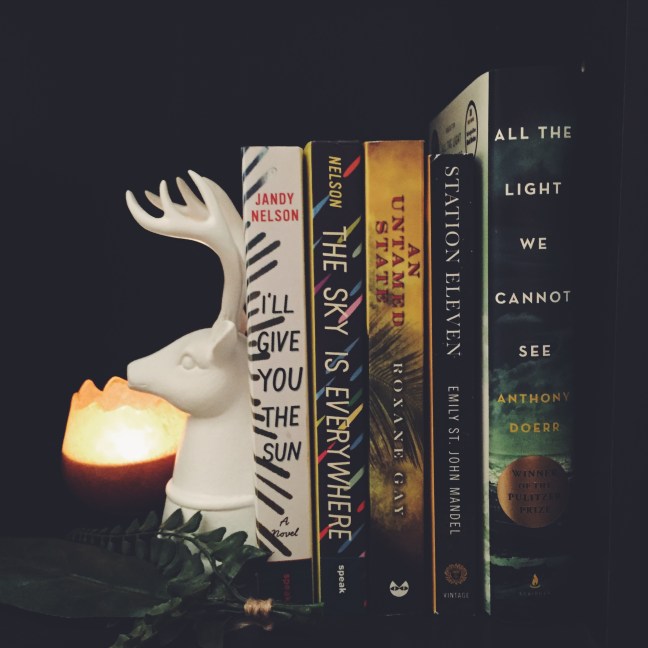
Processed with VSCOcam with f2 preset

To-date, I’ve read 31 (and a half) books this year. That may not be a lot for you, but for me, it’s quite the achievement. And of these 31.5, many moved me.

While beautiful technical victories of character development and diction and so on, these stories stuck to my memory like static cling because of what the stories provoked in me. And I can’t let them go.

So, why am I telling you this? This is not an A+B=C blog post. Instead, as it is the end of the year, a time upon which we reflect, I wanted to share the favorites of my favorites with you. And I’m not going to talk about their brilliant writing techniques—of which there are plenty. Instead, I’m going to tell you why they moved me, in hopes that they might move you too.

I’ll Give You the Sun & The Sky is Everywhere by Jandy Nelson

I’m obsessed with these books. Lapped them up like melting ice cream on a hot day. In fact, I actually listened to both of the books while on separate business trips that required me to drive long hours alone. And you know it’s a good book when you get to your destination and are sad to leave the car. So, why did I love Nelson’s books? While the coming-of-age stories were wonderful, the way in which she tells the stories is exquisite. It’s downright stunning. She has a way of writing her teenage characters with such vigor and color and poise that her words changed me. I felt charged with the reckless youth of my former self, and the world around me was a bright opportunity for adventure.

I believe the power of her books consists of more than her ability to write characters with a strong voices or her use of strong dialogue (both of which she’s obviously spectacular at doing). After all, I’ve read books with stellar voice and realistic dialogue before, but I’ve never had this kind of visceral reaction to a story.

I wanted to stick my head out the car window and scream sweet nothing into the streaming night air, I wanted to sneak out of my own house, meet friends on the merry-go-round and get drunk on cheap rose wine, I wanted to live.

An Untamed State by Roxane Gay & Station Eleven by Emily St. John Mandel

These books are very, very different. The former is a heart-wrenching story of woman’s kidnapping, fight for survival, and then fight to find normalcy, and in the latter, our world is struck by a deadly flu that kills 99.9% of the population and how the .01% learns to move forward and start again. But here’s why I can’t get either of them out of my head, (SPOILER ALERT) neither can move on, not really.

Gay’s protagonist experiences…honestly, it’s hard to even talk about it. Just know, it’s brutal. And her character is not okay. Not by a long shot. Even in the last pages of the book, after fighting for years to regain a sliver of the life she had, the woman she was before she was kidnapped, she (SPOILER) sees her attacker and unravels. The end.

At first, I was angry. I was rooting for her! I cared about her! How could all or her hard work be gone just like that? I was venting to a friend about it one day, a friend who had also read the story, and she just looked at me—and with that look, I was undone. Here’s why this story matters: Gay so gracefully, tactfully, and honestly portrayed trauma in a way I have never read or experienced before. I believe she is respectful but true to what so many people go through. And in this world, well, I don’t have to tell you—people are not always okay. Things happen, and it changes them. Sometimes you can’t go back. There may only be a different future. A new normal.

Similarly, that’s why I also keep returning to Station Eleven, except in this case, instead of one character going through physical and mental trauma, it is an entire world that has changed and the select few who must somehow continue living. This story isn’t one about survival: it’s about starting over and about how to keep a microscopic piece of civilization, of history, of art alive. Can you imagine? Losing not only necessities like electricity, medicine, pre-packaged food, but also losing thousands of years of history, culture, customs, language, stories. Furthermore, can you imagine knowing what you lost? Knowing there used to be such a thing called the Internet, but having no idea of to bring it back from the grave?

One of the main characters we follow is part of a traveling symphony. A group of musicians and actors that move from town to town, giving Beethoven and Shakespeare back to a world that hasn’t heard music or tales of woe in 20 years—and just like that, I was struck by the beauty of such a simple thing. Repeatedly, I found myself in their shoes, grieving with the characters, wondering with them, and wandering with them. And I was bizarrely grateful, in this fictional world, to know that Beethoven’s 9th and A Midsummer Night’s Dream survived. It’s been five months since I finished the story, and I’m still grateful the violin lived.

All the Light We Cannot See by Anthony Doerr

Winner of the Pulitzer Prize for fiction, Doerr’s prose leaves you bruised with life and beauty and—if you’re a writer—jealousy. But this isn’t why his story moved me. Throughout the novel, he moves back and forth between the two main characters, a young boy growing up in Germany under Hitler’s influence in the 1930s and a young blind girl living in France during the upcoming and eventual war. Back and forth like a game of tennis, we get their stories in snapshots. Until, finally, in the eleventh hour when their paths ever so briefly cross.

The moments between them are an innocent reprieve from the loveless world from which they both came and to which they must return. This is why I can’t them go. Separately, they’re great characters. I loved them, and wished them well. But because of who they became for each other, even if it was only for a handful of pages, I can’t forget them. Each is memorable for his and her actions toward and with the other.

Now what?

So, you’re asking yourself, how do I do this? What do I take away from this besides a to-read list? Honestly, I’ve no idea. I’m still learning too. And like I mentioned earlier, I could dissect some of the technical achievements of their works, and perhaps I’ll do that another day, but I think that would be missing the bigger opportunity. I fell in love with these stories because they brought out something true in me and what I believe are some of the truest pieces of what it means to be human.

Something about these stories has punctured the piece of myself that only music can speak to. The emotions, the soul those melodies alone evoke.

So, in 2016, find those stories for you and let them move you. After all, what’s the point of all of this if these things don’t change us? So, go. Find your violin.


8 Great Gift Ideas For Writers

The holidays are upon us, and if you’re like me, you’re scrambling to get a few ideas for the friends, in-laws and loved-ones on your list. On the flip side, when someone asks you for your wishes and wants, it can feel somewhat awkward to give them a list.

Whether you need a few Christmas gift ideas for writers in your life, or you’re the writer looking to give someone a few ideas, this post is for you.

8 Holiday Gift Ideas for Writers

Some of these ideas are perfect stocking stuffers or secret santa presents, while some are “I’ve-forgotten-the-last-3-birthdays-and anniversarys-and-I’m-making-up-for-it.” Hopefully you can find a few that fit your budget and personality!

image1

  1. A packet of really great pens. These make easy, practical stocking stuffers. My fav is the Pilot Precise V7, but there are a lot of great pens out there. Pay attention to how your friend or loved-one signs their receipts or writes in their planner; if they tend to favor one pen, that’s your go-to gift.
  2. ‘Novel-Teas’ tea packets. For the tea-lover writer in your life, this is a perfect literary gift that can actually be consumed. Put it in a mug, and you’ve got a great little gift. (Pictured above)
  3. A vintage typewriter. Cuz pretty much every writer wants one. Actual vintage can be expensive and might not work. So a hybrid between the two might be what you’re going for. This qwerkywriter keyboard looks vintage but can actually connect to a smart tablet!
  4. A really great pocket notebook. Again, there are so many options out there. This Rite in the Rain pocket notebook is just one, but is pretty unique in that it’s waterproof–perfect for the writer inspired by nature or while in the bathtub.
  5. A personalized leather journal. Not all writers like to journal, but the ones who do tend to cherish their journals and appreciate the kind of paper and quality of cover. To get started with your search, check out these personalized leather journals on etsy.

  6. Gift cards. If you’re really in a bind or kind of a last-minute-louie, gift cards to Barnes & Noble, local bookstores or favorite coffee shops are always a welcomed surprise.
  7. Ironic clothing. For the writer in your life with a sense of humor, these pencil scarves on etsy and these pencil socks from Modcloth are pretty much perfect.
  8. ‘Writer’s block’ toolbox. This is a great gift idea for the aspiring writer or English/writing teacher. This little toolbox offers fun ways to keep the creative juices flowing and is getting great reviews on Amazon.

Add your idea!

I’m sure there are zillions more great ideas out there, so feel free to comment some of your own favorite gift ideas or past presents!

*originally posted on suzieruewrites.com